
EVIDENCE AND METHOD
Karto modelling
Karto combines public and local data with adjustable assumptions. Teams can see how results were calculated and update the plan as evidence changes.

Answer the questions the plan turns on.
PLANNING QUESTIONS
How much housing is needed by type?
How could homelessness change over the next ten years?
Which housing and service responses should the community plan?
What will the proposed portfolio cost over thirty years?
What outside funding is required?
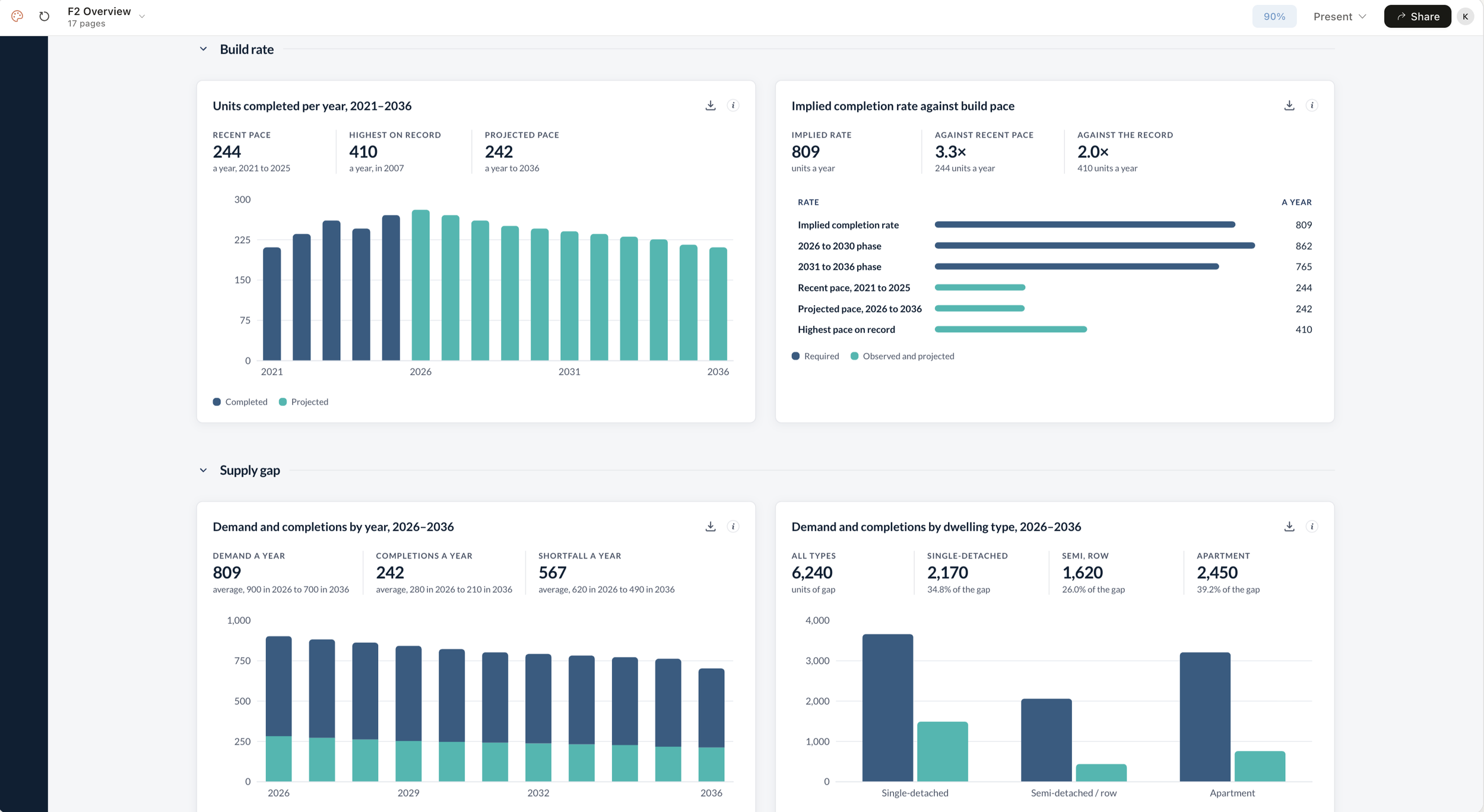
Reproduce every result.
CONSISTENT CALCULATIONS
Karto's calculation engines produce consistent projections and financial results.
This matters because teams can:
Review scenario data and assumptions
Reproduce a result
See the effect of one changed assumption
Compare options consistently
Document a recommendation
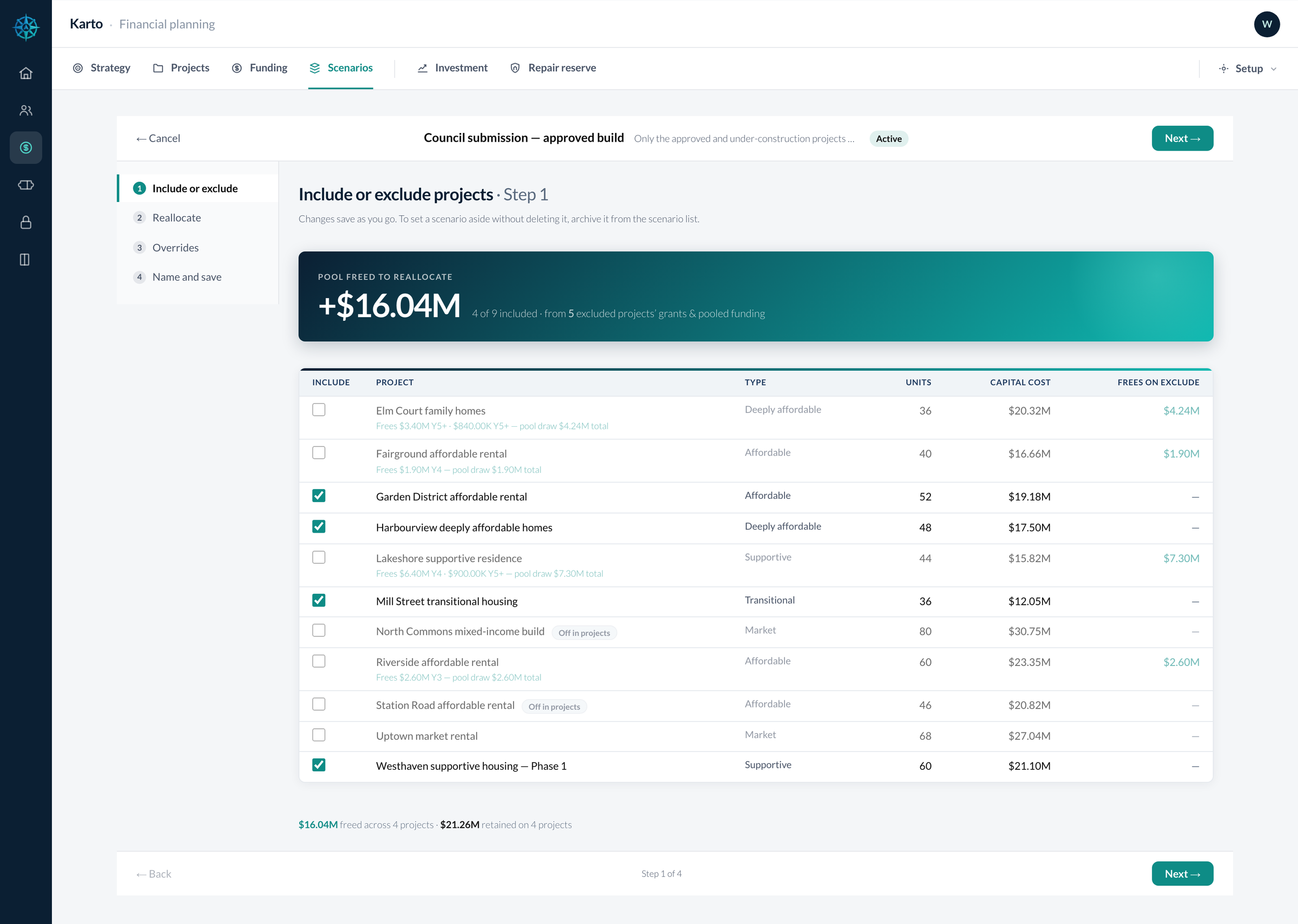
Estimate need, then close the gap.
HOUSING MODELLING
Estimate housing need by type, compare supply scenarios and see how each changes the gap.
Use the results to set unit targets and define the portfolio.
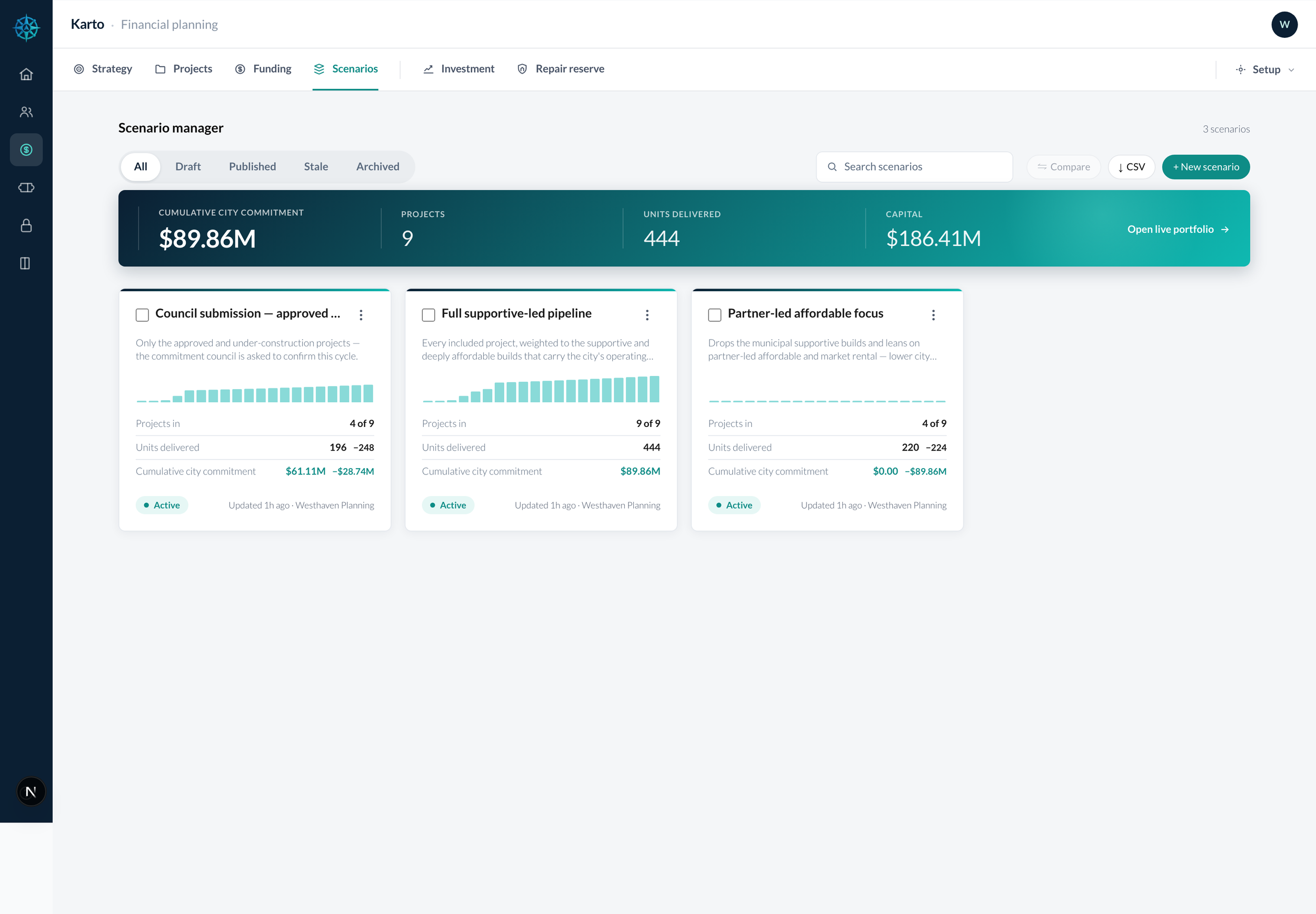
Build the homelessness model in four steps.
HOMELESSNESS MODELLING
-
Enter homelessness, capacity, performance and cost data.
-
Karto produces 25 ten-year estimates across growth and self-resolution assumptions. Staff select the most plausible baseline.
-
Change prevention, capacity, supportive housing, deeply affordable housing, performance and budget.
-
Compare projected homelessness, people housed or prevented, system pressure, cost and remaining need.

PORTFOLIO PLANNING
Cost the portfolio over thirty years.
01
Model projects separately
Set each project's capital, operating, revenue, financing and repair assumptions.
02
Combine the projects
Combine project pro formas to see units, housing mix, costs, revenue, debt, repairs and funding gaps.
03
Test uncertainty
Compare project mixes, timing and outside funding assumptions.
04
Use a thirty-year horizon
Keep operations, debt and repairs visible beside the capital decision.
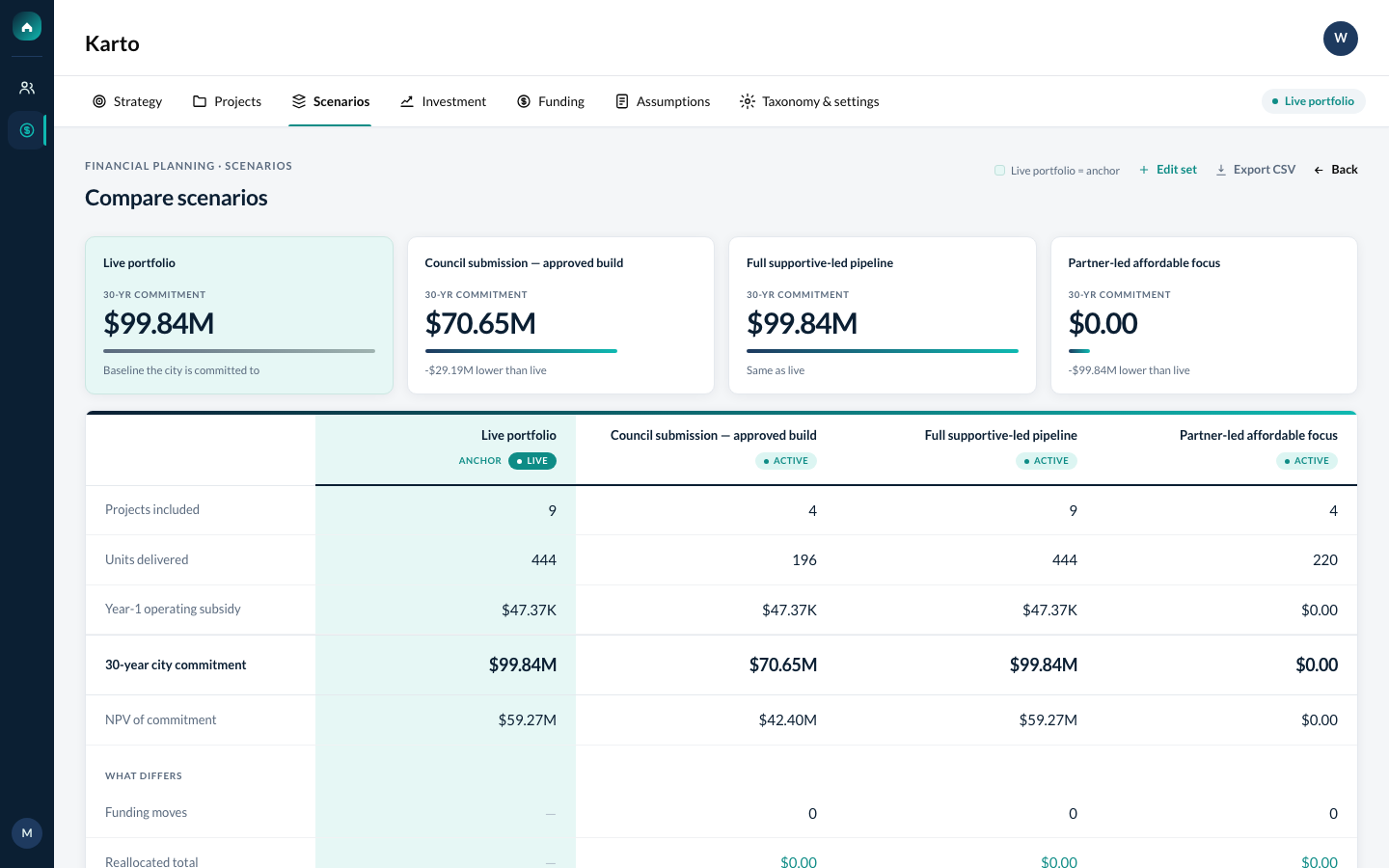
Compare project and funding mixes across capital, operating and long-term municipal costs.
USING GGOD EVIDENCE
Document the inputs.
Strong scenarios require good inputs and local judgement. Karto provides the method; municipal staff and HelpSeeker provide context.
Document:
Each input's source and period
Known coverage gaps and limitations
Rationale for key assumptions
Differences between local and public data
Triggers for review
ARCHER
Ask Archer.
Ask Archer questions in plain language. It explains results, compares scenarios and explores responses using the community's Karto data and models.
Staff control the plan.
See how Karto works end to end.

NEXT STEP
Review the method.
See the inputs, assumptions, calculations and outputs. Karto turns HelpSeeker's municipal modelling methods into software teams can use and update.